Historical declines in essential minerals in fruit and vegetables have been found in several countries including the UK and USA. They raise a clarion call for improving food systems to improve the nutritional value of foods for people and animals. Crop yields have increased but vegetables and grains have experienced a steady, measurable decline in essential micronutrients. Consumers today may need to eat double or triple the amount of certain vegetables to obtain the same nutrition their ancestors did a century ago.

Importance of Mineral Nutrition in Humans
Mineral nutrition is highly important for the proper functioning of the human body. Listed below are key minerals found in humans:
- Calcium: Necessary for proper structure and function of bones and teeth and assists in muscle function and blood vessel contraction.
- Phosphorus: Part of bone and cell membrane structure
- Magnesium: Assists with over 300 enzyme reactions, including regulation of blood pressure.
- Sodium: Electrolyte that aids fluid balance and maintenance of blood pressure
- Chloride: Helps maintain fluid balance and is used to make digestive juices.
- Potassium: Electrolyte that maintains fluid status in cells and helps with nerve transmission and muscle function.
- Sulfur: Part of every living tissue and contained in the amino acids methionine and cysteine
- Manganese: Assists in carbohydrate, amino acid and cholesterol metabolism.
- Copper: Required for connective tissue formation, as well as normal brain and nervous system function.
- Zinc: Necessary for normal growth, immune function and wound healing.
- Iodine: Assists in thyroid regulation.
- Fluoride: Necessary for the development of bones and teeth.
- Selenium: Important for thyroid health, reproduction and defense against disease.
Micronutrient deficiency is a worldwide problem affecting more than 2 billion people, mostly poor women, infants and children with diet lacking key micronutrients. The Middle East faces many challenges with conflict zones, imported grains, limited diets, and challenges of drought and depleted soils.
The explanation is simple, solutions are not
1. Quantity vs. Quality
The single largest driver is selective breeding to develop crops that grow faster, yield more, provide more calories of food and resist pests. The health and quality of life implications of declining crop nutritional quality for human and animal health have been neglected. For example, modern high-yielding hybrid maize varieties produce larger starch-dense kernels without a proportional increase in trace mineral uptake. This effect further lowers the baseline concentrations per kilogram of grain.
2. NPK Fertilizers
Research in the 1800s identified essential elements for plant growth. By the 20th century a massive shift to synthetic Nitrogen, Phosphorus, and Potassium (NPK) fertilizers took place.
Large applications of fertilizer N and P inhibit micronutrient uptake by fungi and plant roots. The transition to chemical fertilizers in modern industrial agriculture triggered a steady dilution of crop nutrition. The steepest declines occurred after 1950, as intensive farming practices and heavy use of NPK fertilizer began. Total Fertilizer Growth across nitrogen, phosphate, and potash grew from 2 million tons in 1940 to 46.3 million metric tons in 1965 and 206 million tons in 2024.
3. Soil Organic Matter
Monoculture farming degrades soil structure, lowers soil organic carbon, and reduces microbial diversity. Beneficial soil microbes and organic matter are essential for cycling micronutrients and keeping them in soluble, exchangeable fractions. Ecological studies of roots and symbiotic fungi have made it clear that soil organic matter is critical, but often neglected. Arbuscular mycorrhizal fungi and vesicular mycorrhizal fungi form symbiosis with plant roots. The fungi improve uptake of soil nutrients compared to roots alone. Agroecological farming methods promote fungal symbiosis. Minimum tillage, increased organic matter, and agro-biodiversity favor development of these symbioses.
4. Soil acidification
Heavy applications of synthetic nitrogen fertilizers in continuous systems can lower soil pH over time. This can cause problems with nutrient availability. For example, as soils become more acidic, soluble selenate converts into selenite, which binds tightly to iron and aluminum oxides and becomes unavailable to plant roots.
How much has crop quality declined?
Comparing 1940 data to 2010 baselines revealed the extent of the problem with losses of critical micronutrients in many crops in the UK dropping 50% in seventy years. In the US Department of Agriculture datasets showed that concentrations of key nutrients dropped 6–38% across dozens of common garden crops. The steepest declines occurred after 1950, with widespread adoption of intensive farming practices. High application rates of NPK (nitrogen, phosphorus, potassium) fertilizers had few, if any, micronutrients, so the soil has gradually been impoverished as micronutrients were shipped away as part of the crop harvest. Few scientists have been studying the micros and relatively little testing has been done. Most recommendations for fertilizer have just considered NPK.
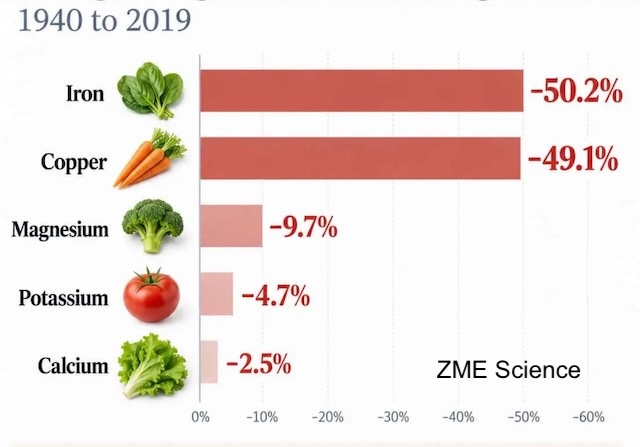
Historic farming practices with manure, guano, compost, green manures, leaves collected from the forest, fish meal, kelp, crop rotation with grazing and other practices had offset some of these losses in the past. The ancient Chinese farming systems did this well for over 40 centuries because they had to. Studies have shown that organic cropping systems that adopt some of these practices had higher nutritional density; but an organic system may have fewer adverse impacts on the environment but still neglect micronutrients.
Why does it matter?
Micronutrients are essential for health. Iron, vitamin B12, and folate are sometimes tested and treated, but a broader set of micronutrients and vitamins are essential for health. These include vitamin A, vitamin B6, riboflavin, vitamin C, vitamin E, trace elements such as copper, zinc, selenium, and more. The lack of key trace elements can lead to a range of disorders, as well as slow healing, failure to thrive, birth defects, heart disease, cancer, stroke, diabetes, anemia, low birth weight, neurological problems, and child growth retardation.
Micronutrient malnutrition affects almost half of the people in the world, particularly the poor. Deficiencies impair growth and cognitive development, make people more vulnerable to infectious diseases, and result in other physical disabilities. Micronutrient deficiencies contribute to many diseases even in developed countries. These health problems diminish quality of life and have substantial social and economic costs, making them both consumer and public health issues.
For example, teenage girls are particularly vulnerable, and even in the US, they consume less than the recommended level of magnesium and iron. Iron intake is important for women due to high demands of menstruation, pregnancy and lactation. Magnesium is important for bone, nerve and muscle function. Calcium is needed for a range of functions including bone development, so poor intake during adolescence is a concern. Nutritional density is important for people taking GLP-1 therapies. By reducing appetite and overall food intake, these therapies may increase the risk of micronutrient inadequacy. Many of these issues have lifetime consequences.

Micronutrient deficiency also leads to disease or disorders in animals. This can occur with low or zero micronutrients in fertilizer after years of crop removal or in animals grazing on soil with low selenium levels, these are widespread in California. Animals can experience a wide range of disorders and diseases, including anemia, goiter, retained placenta, failure to thrive, and diarrhea. Selenium deficiency has been linked to nutritional myodegeneration (with cardiac and skeletal muscle damage in calves and lambs), reduced fertility, and weaker immune systems. These types of disorders also occur in wildlife in areas with very low selenium levels in the soil.
Salt blocks often provide common micronutrients. While they are convenient and weather-resistant for grazing pastures, their actual effectiveness depends heavily on animal behavior and mineral formulation.
The future
Agriculture has to be considered as a complex ecosystem and economic challenge. The quality of food is important for public health, farm economics, and agro-ecosystem resilience and yield. With the réductions in quality now known across crops and nations it is necessary to take a more holistic approach rather than ignoring micronutrients or considering each nutrient by itself. Foods can be grown and processed in ways that optimize their nutrient content from production to consumption and return nutrients to the fields. Research is critically needed to develop more effective methods for restoring soil health and improving financial returns for providing higher quality foods.
One of the challenges is returning macro and micro nutrients to the land after the food is eaten, digested and flushed away –– down sewers to pollute waterways. Studies attempting to close the circle of macronutrients have proved challenging enough. Modern cities operate as linear one-way pipelines that import nutrients in food and flush them into waterways or bury them in landfills, causing both resource depletion and severe algal blooms. The reliance in some countries on imported foods makes the return of nutrients almost impossible. Macronutrients have been studied in some areas in an effort to reduce fertilizer runoff and pollution. In the US this runoff has resulted in a Dead Zone in 2026 of 350,000 hectares in the Gulf of Mexico. Micronutrients may be even harder to recapture, but completing the nutrient cycles is essential.
Lessons have been learned in dealing with the macronutrients. For example, full-scale plants operated by Aarhus Vand at Aaby and the Marselisborg wastewater treatment plants in Denmark use reactors to precipitate phosphorus as struvite granulate. This is approved for use as agricultural fertilizer. Recapturing nutrients is easier if the waste stream is free of pollution. If the sewage sludge is not contaminated it can be composted and reapplied to farms.
Research is urgently needed to better understand the opportunities for closing the circle of micronutrients. More complete consideration of the economic and quality of life benefits of improved nutritional quality is needed. Complex fertilizers with locally developed specific micronutrients blends can help. Some livestock already get some of their micronutrients from regionally adapted micronutrient levels in salt blocks. These are often color coded to identify inclusion of specific micronutrients.
Micronutrients are essential for health. Low levels can result in lifelong health problems and costs. The decline in nutrient quality needs to be recognized and addressed. Continuing production of low-quality crops has high health and economic costs. We can and must do better.
Sources of Information
Galal OM. 2000. Micronutrient deficiency conditions in the Middle East region: an overview. Public Health Review. 28(1-4):1-12.
Ministry of Health, UNICEF, WFP, Jordan Health Aid Society International, Department of Statistics, Biolab, GroundWork, Jordan. 2021. National Micronutrient and Nutritional Survey 2019. Amman, Jordan
Mayer, A. M. B., Trenchard, L., and Rayns, F. 2022. Historical changes in the mineral content of fruit and vegetables in the UK from 1940 to 2019: a concern for human nutrition and agriculture. International Journal of Food Sciences and Nutrition. 73(3):315–326.
Welch, R. M. 2001. Micronutrients, agriculture and nutrition: Linkages for improved health and well-being. In K. Singh, S. Mori, & R. M. Welch (Eds.), Perspectives on the micronutrient nutrition of crops. pp. 247–289.
David A. Bainbridge is an esteemed ecologist, author, teacher, and historian. His areas of expertise are desert restoration, sustainable agriculture, ecological economics, and more. With over 50 years of experience and a prolific output of over 300 articles, many books and book chapters, David Bainbridge continues to pioneer in the field of sustainability.


